
FRENCH PUBLIC HIGHSCHOOL – PIE
Price range: € 7,050 through € 7,950
Flights not Included
Description
Spending a French school year abroad in France
Why? When? How? Motivations, living conditions, school and family life, registration, preparation, follow-up. A brief overview of the program’s main components.
Five good reasons to spend a school year studying abroad
1. Learning a language : Being immersed 24 hours a day for nearly 10 months in another linguistic environment; becoming fully familiar with the “new” language, understanding and speaking it; mastering it in everyday life (dialogue, telephone, television, etc.), in studies (school, university) and in professional life. Thus opening oneself up to bilingualism.
2. “Learning a culture”: Discovering a country, understanding its unity and differences, and learning to adapt to it. Gaining experience and maturity in this way.
3. Prepare for your future : Increase your chances of academic success and future professional success: a year abroad is a major asset in your educational path, a significant advantage when taking competitive exams or applying for jobs. Spending a year abroad is a long-term investment.
4. Gaining independence :
Having the strength to leave one’s familiar environment. Upon returning, gaining a better understanding of one’s country and surroundings; appreciating one’s loved ones (family, friends, etc.) for who they truly are.
Learning to manage on one’s own and to cope, without direct parental assistance, with the challenges of everyday life and more exceptional situations.
Learning to navigate unfamiliar territory; knowing how to react to new and sometimes even unexpected events.
5. Getting to know yourself better , a journey within yourself :
This extended stay, occurring at a pivotal point in life, is a unique opportunity to take on responsibilities, broaden your horizons, and flourish. Over the weeks and months, each participant rediscovers their deepest motivations. Confronted with new norms, they uncover new abilities and interests. At the end of the experience, they learn to know themselves better.
The best time to leave
The age of 15-18 is ideal for extended stays abroad. It’s the time when childhood is closing its doors, when one dreams of change and escape, but also, more than ever, needs structure and guidance; it’s the age when one can still learn a foreign language to the point of making it a second language; the time of life when adapting to new norms is still relatively easy; and finally, the time when readjustment (cultural, and especially academic) is easiest. We still hear talk of a “lost” year. What nonsense! Those who speak this way disregard the knowledge, skills, energy, experience, and joys accumulated throughout the year. In fact, when exchange students return, they all proudly speak of “their year spent abroad.” Not one, to our knowledge, refers to “their wasted year abroad!”
The host family
A host family is a family like any other. In other words, a family unlike any other. Hosting is open to all volunteer families who wish to host and who are able to share their activities, hobbies, and daily life with a young person.
PIE’s partners abroad (and their representatives) are responsible for informing the host family about the realities of the exchange program. The initial contact is followed by a home visit. The representative, who is familiar with the program and its requirements, can provide the family with objective information, address their concerns, and assess their capacity to host. A family is selected because the representative considers them well-balanced, enthusiastic, and caring (with supporting references). In this case, the representative helps the family choose a young student, taking into account, as much as possible, compatibility and potential incompatibilities. The ideal family doesn’t exist, nor does the ideal participant. If a perfect match is achieved, it is the result of living together. Because the story of a year abroad is above all the story of a relationship built day by day, embracing the happy moments and overcoming the challenges.
The school
Because each school system has its own objectives, pace, cycles, structure, subjects, connections, and modes of interaction (teachers/students, students/students, parents/teachers), it is particularly difficult to discuss schooling briefly. However, it can still be said that, regardless of the school, it is through it that exchange participants, in the vast majority of cases, manage to integrate into their host country. The foreign school, inevitably very different from the French school, surprises, motivates, and offers genuine opportunities for personal growth. It is thanks to the school that most leisure activities, sports, and social interactions take place. It is often around the school—certainly much more so than in France—that life and social practices are shaped. The school is a true place of exchange. It is therefore strongly advised that a young student actively participate in it.
The language question
Provided that PIE has deemed the candidate fit to go and that they have completed their preparation work as required, the language barrier will be quickly overcome. The fatigue of the first few days (concentration difficulties, comprehension problems) will soon give way to a certain ease. Then will come dreams in English, Portuguese, or German, long phone conversations, and mistakes… in French! But a very insufficient level of language can be a handicap (especially at first); it should therefore not be taken lightly. It’s worth noting that a year spent in an English-speaking country is very beneficial for language learning, but it’s even more so in countries like China, Japan, and Russia. We have so little contact (cinema, music, radio, television…) and are so unfamiliar with these languages that immersion is practically essential for learning them properly. It should also be noted that in Scandinavian countries, English language learning is very advanced and the prospects for progress in this language for someone who spends a year in one of these countries are enormous.
The question of adaptation
Integration abroad involves adapting to new customs and recognizing the need for mutual exchange. A family and a community welcome a new person. This person must be ready to receive but also to give. In their new home and school, the exchange student will be considered neither a guest nor a tourist. The world and society will not transform for them, but they will open up. Therefore, to become a full member of this family and this country, they will need to observe, appreciate, and, to some extent, imitate. The goal of the year is not to challenge others, but rather to find common ground, to discover shared values.
Registration and preparation
If a candidate is considering leaving, here is the procedure they must follow:
1° — Request for a registration file from the national office.
2° — PIE sends a file to the candidate and makes direct contact with him.
3. The delegate or French correspondent invites the prospective participant to an individual interview. During this interview, they discuss the main stages of the program with the applicant. The delegate or correspondent provides the prospective participant with detailed information. They also seek to better understand their motivation and get to know them better. They answer their questions. Their goal is to help the prospective participant prepare their application and, at the same time, ensure that they possess the necessary qualities to succeed in their year abroad (a minimum level of open-mindedness, motivation, flexibility, and realism, as well as sufficient language proficiency – as assessed by a test). A meeting is also held with the applicant’s parents.
4° — Return of the registration file. The candidate must ensure that it is completed quickly, but carefully, seriously and attentively.
5° — Upon receipt of the complete application, PIE will provide its decision regarding acceptance. The association selects an application based on the entire application (academic, medical, language level, cover letter, etc.) and the interview report.
6° — During the period following acceptance and preceding departure, the participant is invited to prepare personally by studying the language, history, geography, social life, customs and traditions… everything that characterizes the country that is about to welcome him.
Orientation and follow-up internship
While PIE’s role (and that of its partners) includes selecting participants and finding them host families, its primary purpose is to ensure the success of their stay. This is why our organization holds an orientation workshop before departure.
This workshop, which lasts just over 48 hours, serves as preparation. The goal of this meeting is to get to know each other better, answer everyone’s questions, motivate the future participants… or perhaps temper their enthusiasm. Through meetings and discussions, participants learn practical details (travel, insurance, lifestyle, schools, regulations, etc.), learn to take advantage of all the opportunities offered by life abroad, become aware of common pitfalls to avoid, and learn how to handle difficulties. Ultimately, they approach the year with a more realistic perspective. Parents, who are invited to the first half-day of the workshop, are introduced to the organization (the main issues are addressed) and to the idea of leaving their child for an extended period. This workshop takes place in May or June.
During the stay
Throughout the year, communication between the association, the participant, and their parents is never interrupted. It remains maintained thanks to:
- To a network of delegates abroad. These delegates are often passionate about these exchanges. They have frequently experienced them themselves. They can help, throughout the year, to create lasting bonds with the host family; they can support and guide all parties involved should any problems arise. They know the country, the region, and the family where the participant will be staying very well.
- To the foreign correspondent of PIE. During the year, the latter offers the opportunity to participate in visits and meetings.
- To a French network (regional managers, delegates and PIE correspondents).
- Through the “Trois Quatorze” newsletter, the website, and the alumni network (“PIEC”), participants exchange information, follow PIE’s activities, share their experiences, and indirectly contribute to the experiences of others. PIE supports participants throughout their experience. The association remains available to guide them, particularly in case of difficulties (contact is always possible, emergency number provided).
CLICK ON IMAGE FOR MORE
Additional information
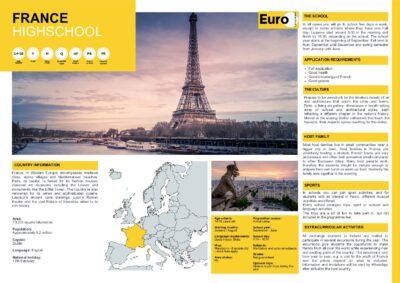
| Duration | 2 months, 3 months, Academic Year, Deposit, Semester |
|---|
High School Classic
High School in France
High School Classic
High School Classic is the traditional high school exchange programme, chosen by most of our students. It is the perfect programme for those who long for a genuine high school experience abroad and who are willing to embrace all the surprises it can bring. Here’s how it works: based on your profile, we match you with a host family and school, and the best part is, it can be anywhere in France, from the Paris region to the rugged coastlines of Brittany! If you’re open to adventure and are willing to let yourself be surprised by your exchange experience, this is the programme for you.
Excellent education in France
As an exchange student in France, you will get to know the country from the inside, beyond the typical tourist attractions. Two years of French language study is recommended, but not required. While living here you will constantly improve your language skills and become fluent in a world language, possibly one of the most romantic ones. The French educational system is considered one of the best in the world. A year in France will be beneficial for all your further education.
Your School
Le lycée
In 2019, the French Education system underwent a reform which enables a more ‘à la carte’ approach to classes. Your school will decide your placement based on your application, age, grades and language level.
Your schedule
If you are placed in year 11 or 12 you will have the following mandatory subjects : French, Philosophy, History/Geography, Moral and Civic Education, two foreign language classes, Physical Education, Scientific and Digital Humanities. In addition to those you might be able to pick some extra classes depending on availability.
You usually go to school six days a week, however, Wednesdays and Saturdays are normally shorter.
Host Family
Family is important to the French and life revolves around the close-knit household. As a new family member you will be introduced to the French culture and the typical traditions of your particular family. When you gather around the dinner table to talk about your day, you will hear new words and expressions, which will sharpen your grip of the language.
What’s equally important to the French is of course food. This is the culinary heart of the world with lots of classic dishes. You might be served coq au vin, poulet basquaise or boeuf bourguignon.
North, south, farm or city
What your new home will look like depends on where you are placed. To live with a family in the north is naturally quite different from life in the south. Living on a farm in the country is something different than an apartment in a city. It’s good to know that many French families have pets, they sure love their four-legged friends. If you have any allergies, please let us know.
Free Time
Free time in France
Your leisure time in France will be rich and varied – and it’s up to you what you want to do. Your options are nearly endless. For instance, if you like shopping you will think you are dreaming. The department stores and smaller boutiques are full of the latest fashion. Your wardrobe will become full of unique French garments.
Cozy cafés
Did you know that the word café is French? This is a word that will become pretty standard in your vocabulary, since visiting cafés with friends will be something you will do a lot. Hanging out in cafés is typically French. Order a café au lait and just sit and talk for hours. Can you think of a better way to practice your French?
Tour de France and much more
Near the Alps, there is a lot of fishing, skiing and mountain climbing. As you move towards the South, water sports and beach life rule. The French are fond of all kinds of sports, both individual and in teams. Cycling is one of the national favourites. When the prestigious Tour de France begins the whole country follows the contest from start to finish. Maybe that’s a sport you want to try during your high school exchange?
See more of France
Forget about school and homework for a while and join one of our trips within the country. You will travel with other exchange students and always with experienced leaders. We offer a wide range of trips around France. Travel schedules and prices may vary. Your local contact person will provide you with all the necessary information.